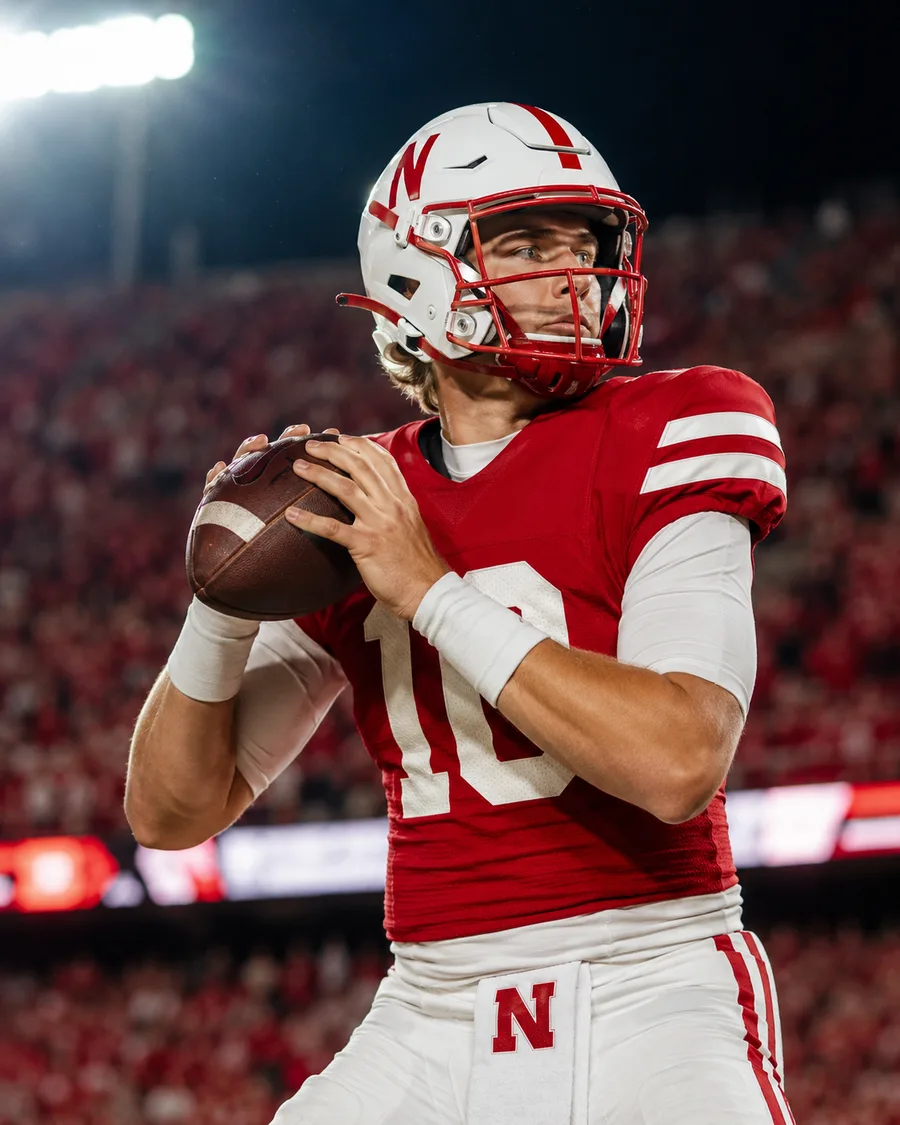
Here’s the strange thing about Nebraska heading into 2026: the program is healthier than it’s been in years, and it just lost its two best players anyway. The Huskers went 7–6 in 2025, reached a second straight bowl (their first consecutive trips since the 2015 and 2016 seasons), and rewarded Matt Rhule with a contract extension. Progress, real progress, after a decade in the wilderness.
And yet. The year ended with a thud — a 40–16 home beatdown by Iowa, then a 44–22 Las Vegas Bowl loss to Utah — and the offseason ended worse: quarterback Dylan Raiola transferred to Oregon, and Big Ten Running Back of the Year Emmett Johnson left for the NFL Draft. So the question for 2026 isn’t “is Nebraska back?” It’s “who’s left, and is it enough?”
What BBMI’s model says
This is where we come in. BBMI’s preseason model has Nebraska 37th nationally and 10th of 18 in the Big Ten — squarely mid-pack, a solid and respectable roster rather than a bottom-feeder. From there, the model’s real work is at the game level: we run every matchup on the schedule to a win probability.
The bigger story is the schedule, and it’s a tale of two halves. The non-conference slate is a cupcake tray — Ohio, Bowling Green, North Dakota — and the model has Nebraska heavily favored in all three. Then the Big Ten schedule turns vicious in the back half: road trips stacked up, plus dates with Oregon, Indiana, and Ohio State, three of the sport’s genuine heavyweights. The Huskers are underdogs in all three by 15-plus. The season, realistically, gets decided in the middle tier — win-leans against Michigan State, Maryland and Rutgers, and genuine toss-ups at Washington and Illinois.
The schedule, by win probability
BBMI preseason modelA cupcake non-conference tray, then a vicious back half. The season gets decided in the coin-flip middle.
That model lands on 6–6 (3–6 Big Ten), about 6.2 expected wins — a third straight bowl, and right in line with the betting markets: some early books posted Nebraska at 5.5 wins, and by mid-July FanDuel and BetMGM were dealing 6.5. Not a leap. Not a collapse. The most Nebraska thing imaginable: right on the bubble again.
What the staff actually changed
Two moves define the offseason. On offense, continuity: Dana Holgorsen — who joined the staff late in the 2024 season and took over play-calling — signed a two-year deal to stay as coordinator. On defense, a clean break: Rhule fired coordinator John Butler on December 1 after the unit gave up 77 points across the Penn State and Iowa losses to end the year, and hired Rob Aurich away from San Diego State. Aurich’s 2025 SDSU defense ranked 5th nationally in scoring (12.6 points a game), and he’s bringing a scheme change with him — Nebraska moves from a 3-3-5 to a 4-2-5 base.
The through-line: Rhule is doubling down, not blowing it up. Which brings us to the man himself.
The quarterback question
For two years, this section would have written itself: Dylan Raiola, the five-star who started as a true freshman, was the face of the rebuild. Not anymore. Raiola broke his fibula against USC in November, and when the portal opened in January he left for Oregon — where, for now, he’s a backup behind Dante Moore. (His younger brother Dayton went with him.) The franchise quarterback left to hold a clipboard in Eugene. That’s the kind of thing that happens to programs still climbing.
So it’s an open competition, and the front-runner is Anthony Colandrea, in from UNLV, where he threw for 3,459 yards and 23 touchdowns and was the Mountain West Offensive Player of the Year. He’s reportedly separated himself in spring ball. Pushing him is TJ Lateef, a sophomore who was thrown into the fire as a true freshman after Raiola’s injury — he won his debut at UCLA before the season caved in around him. Colandrea is the experienced, higher-ceiling bet; Lateef is the known quantity with a year in the system. Either way, Holgorsen has to rebuild the position on the fly.
Can the run game survive losing an All-American?
Nebraska’s 2025 offense had a spine, and his name was Emmett Johnson. He ran for 1,451 yards and 12 touchdowns, caught 46 passes, won Big Ten Running Back of the Year, and made himself an All-American. He also declared for the NFL Draft the day the season ended. That’s a massive hole.
Here’s the gamble: Nebraska mostly passed on chasing an established portal replacement — for a second straight year the staff leaned toward internal development — before adding former Penn State back Tikey Hayes in mid-July. Hayes gives the room another option, but he doesn’t erase the concern: the Huskers still enter the season without a proven feature back. He joins holdovers Mekhi Nelson, Isaiah Mozee and Kwinten Ives, plus freshman Jamal Rule, a group with almost no meaningful starting experience between them, to replace the best player in the conference at the position. It’s one of the boldest bets on the roster, and if it doesn’t hit, Holgorsen’s offense loses the balance that made replacing Raiola look manageable in the first place.
The defense: good, until it wasn’t
The 2025 defense was quietly excellent for most of the year — the pass defense ranked among the best in the country — right up until it wasn’t. The late-season collapse (77 points in two November losses, then 44 more to Utah in the bowl) cost John Butler his job and reframed the whole unit as a work in progress. New coordinator Rob Aurich does inherit a genuine building block in linebacker Vincent Shavers Jr., one of the most promising young defenders on the roster — but the back end took a hit: safety DeShon Singleton is gone, off to the NFL as an undrafted signing with Kansas City. So Aurich is replacing an important veteran in the secondary while rebuilding the front seven at the same time.
He spent the portal shoring up that front, adding edge Anthony Jones Jr. (UCLA) and interior linemen Jahsear Whittington (Pitt) and Owen Stoudmire (Boston College) to fit the new 4-2-5. On paper the pieces are there for a top-half Big Ten defense. The catch is the same one every rebuilt unit faces: a new scheme, a new voice, and a November that proved this group can come apart if the margin for error gets thin.
The offseason ledger
The coach: no hot seat here
Worth being clear about one thing, because it’s the opposite of a lot of Big Ten programs right now: Matt Rhule is not on the hot seat. Nebraska signed him to a two-year extension through 2032 in October, raising his buyout to $15 million for the 2025–26 coaching cycle, and athletic director Troy Dannen has publicly said he’ll give Rhule the runway to build — backed by a roughly $600 million Memorial Stadium renovation and redevelopment project. An immediate change is highly unlikely.
What’s not settled is the expectation. Rhule built his reputation on year-three turnarounds — Temple went 10–4 in his third year, Baylor 11–3 — and 2025, his third year in Lincoln, merely matched the seven wins of 2024. The leap didn’t come. The bet Nebraska is making is that it’s still coming, just late, and that back-to-back bowls plus a stable staff are the foundation for it. 2026, with a new quarterback and a rebuilt backfield, is where that patience gets tested.
The in-state angle
Nebraska is the program that built a dynasty on walk-ons and in-state kids, and while the modern roster leans on the portal like everyone else, the homegrown thread hasn’t disappeared. The name to know is Carter Nelson, the athletic tight end from Ainsworth — once the consensus No. 1 recruit in the state — who’s healthy and could see a bigger role in the passing game. Daniel Kaelin, a former Elite 11 quarterback out of Bellevue West, is also in the QB room.
The honest note: the in-state pipeline has thinned the way it has most places. Nebraska lost Lincoln native Malachi Coleman after the 2024 season — he spent 2025 at Minnesota and, in a twist, is now at Wisconsin — among others, and the walk-on tradition that once defined the program is a shadow of its 1990s self. But in a locker room increasingly stocked by transfers, players like Nelson are the reminder of what Nebraska football is supposed to feel like.
BBMI is rolling out college football coverage as the season approaches — we’ll be running the playoff contenders and blue-bloods next. Model ratings are preseason and update as real games are played.
2025 record, bowl, and Iowa result (Wikipedia, huskers.com); Rhule extension through 2032 and buyout (ESPN, huskers.com, CBS Sports); year-three-turnaround context (SI); AD Troy Dannen support and facilities project (ESPN, huskers.com); Dylan Raiola transfer to Oregon and 2025 stats/injury (SI, CBS Sports, Fox News); Anthony Colandrea / TJ Lateef QB battle (Clutch Points, SI, Omaha.com); Holgorsen retained, John Butler fired, Rob Aurich hire and scheme change (CBS Sports, ESPN, Daily Nebraskan); Emmett Johnson production and NFL declaration, and the Tikey Hayes / Jamal Rule RB room (ESPN, Hastings Tribune, Central Nebraska Today); defense — Shavers returning, Singleton to Kansas City, DL additions (SI, Last Word, NFL.com); in-state Carter Nelson / Daniel Kaelin (SI, huskers.com); Iowa rivalry history and 2026 date (Wikipedia, SI, Fox News); win total and outlook (SI, Athlon, CBS Sports). National and conference rankings, win probabilities, expected wins, and the 6–6 record projection: BBMI preseason model, July 2026. Win-total figures reflect sportsbook markets as of mid-July 2026.
Disclosure: analytical and educational content about model performance. Not betting advice.
Continue the series: 2026 Big Ten Football Previews
Eleven Gone to the NFL, Still No. 1: Ohio State's 2026 Season, by the Numbers
Ohio State sent eleven players to the NFL, four of them in the top eleven picks, and lost eight defensive starters. BBMI still grades the Buckeyes 1st nationally at +37.6 and 1st of 18 in the Big Ten, with the No. 1 defense and No. 2 offense by SP+ input — the exact mirror of Oregon, 1.7 neutral-field points behind. They are favored in all twelve games, and the projection is still 10–2: a slate this hard costs even the No. 1 team a game or two.
#1 nationally · +37.6 · 1st of 18 Big Ten · 10–2 projected · favored in all 12NCAAF · Season PreviewEverything But the Trophy: Oregon's 2026 Season, by the Numbers
Two straight 13-win seasons, two straight Playoff exits, and twice in 2025 the same team standing in the way. BBMI grades Oregon 2nd nationally at +35.9 and 2nd of 18 in the Big Ten, 1.7 neutral-field points behind Ohio State, with the No. 1 offense and No. 2 defense by SP+ input and a quarterback who turned down the NFL. The projection is 10–2, and exactly one rated game on the schedule makes the Ducks an underdog: November 7 in Columbus.
#2 nationally · +35.9 · 2nd of 18 Big Ten · 10–2 projected · 38% at Ohio StateNCAAF · Season PreviewSixteen-and-Oh, Then the NFL Came Calling: Indiana's 2026 Season, by the Numbers
Indiana went 16–0 and won the first national title in the program's 139-year history, then sent a program-record eight players to the NFL — including Heisman winner Fernando Mendoza at No. 1 overall. Curt Cignetti reloaded through the portal again. BBMI grades the Hoosiers 5th nationally, 3rd of 18 in the Big Ten, and a projected 10–2 (~7–2): about 9.7 expected wins, no Oregon on the schedule, and exactly one game the model makes them an underdog — Ohio State, at home, on October 17.
#5 nationally · 3rd of 18 Big Ten · 10–2 base case · Ohio State ~40% Oct 17NCAAF · Season PreviewNew Sideline, Same Franchise QB: Michigan's 2026 Season, by the Numbers
Sherrone Moore is out, Kyle Whittingham is in, and Bryce Underwood is back for year two. BBMI grades Michigan 17th nationally, 6th of 18 in the Big Ten, and a projected 8–4 — about 7.3 expected wins — on a schedule with no easy stretch: Oklahoma, Penn State, at Oregon, and a November trip to Columbus where the model makes the Wolverines a 17% underdog.
#17 nationally · 6th of 18 Big Ten · 8–4 base case · The Game ~17%NCAAF · Season PreviewRow the Boat, Again: Minnesota's 2026 Season, by the Numbers
Minnesota is coming off 8–5 and a bowl win with almost everyone back — the coach, the quarterback, the star running back. BBMI grades the Gophers 50th nationally, 12th of 18 in the Big Ten, and a projected 7–5 that sits right on the six-win bowl line: about 6.0 expected wins, four true toss-ups, a defense reloading after losing an All-America safety to Oregon, and a fall of three rivalry trophies capped by an Axe game the model calls the closest on the schedule.
#50 nationally · 12th of 18 Big Ten · 7–5 base case · Axe ~53–47 MNNCAAF · Season PreviewCan the Badgers Climb Off the Floor? Wisconsin's 2026 Season, by the Numbers
Wisconsin is coming off a 4–8 collapse, the Air Raid finally buried, and a coach on the hot seat. BBMI has started modeling college football and the Badgers are one of the first teams up: 67th nationally, 17th of 18 in the Big Ten, and a projected 5–7 (3–6) that's softer than the record looks: about 5.5 expected wins, four true toss-ups short of a bowl, and a season-closing Axe game that grades as the closest call on the schedule.
#67 nationally · 17th of 18 Big Ten · 5–7 base case · Axe ~53–47 MNRelated research
BBMI NCAAF Power Rankings, Week 3: Georgia Takes No. 1, Texas Lands the First Punch, and Oregon Already Has a Problem
The BBMI Top 25 after three weeks, with every move measured against the September 8 board. Georgia is No. 1 at +37.1, Notre Dame is the model's title favorite at 20%, Texas has beaten the team that started September on top, and Oregon has fallen seven spots after Stillwater.
Georgia +37.1 · Notre Dame 20% title · Utah ▲10 · Oregon ▼7NFL · Season PreviewDetroit Is the NFC North Favorite. The First Month Will Test It.
Jared Goff and one of the NFL’s best offenses give Detroit a championship ceiling. A rebuilt offensive line and four games without Brian Branch and Kerby Joseph give it an immediate problem. BBMI rates the Lions fourth of 32 at +4.8, projects 11.5–5.5 with an 86% playoff chance, and makes them 60% to win the division.
#4 of 32 · +4.8 · 11.5–5.5 projected · 86% playoffs · 60% NFC NorthNFL · Season PreviewWhy Plus-22 Is Unlikely to Repeat: Chicago’s 2026 Season, by the Numbers
Chicago won the NFC North at 11–6 behind the best turnover margin in football, and two defenders who accounted for 15 of those 33 takeaways are gone. Pro Football Reference put the Bears at 9.1 expected wins; they won 11. BBMI rates Chicago +1.6, 15th of 32, and projects 9.3–7.7 with a 47% playoff chance — first team out of the projected NFC field.
#15 of 32 · +1.6 · 9.3–7.7 projected · 47% playoffs · 18% NFC NorthSee it live
The live model behind this piece — the same numbers the article is built on.