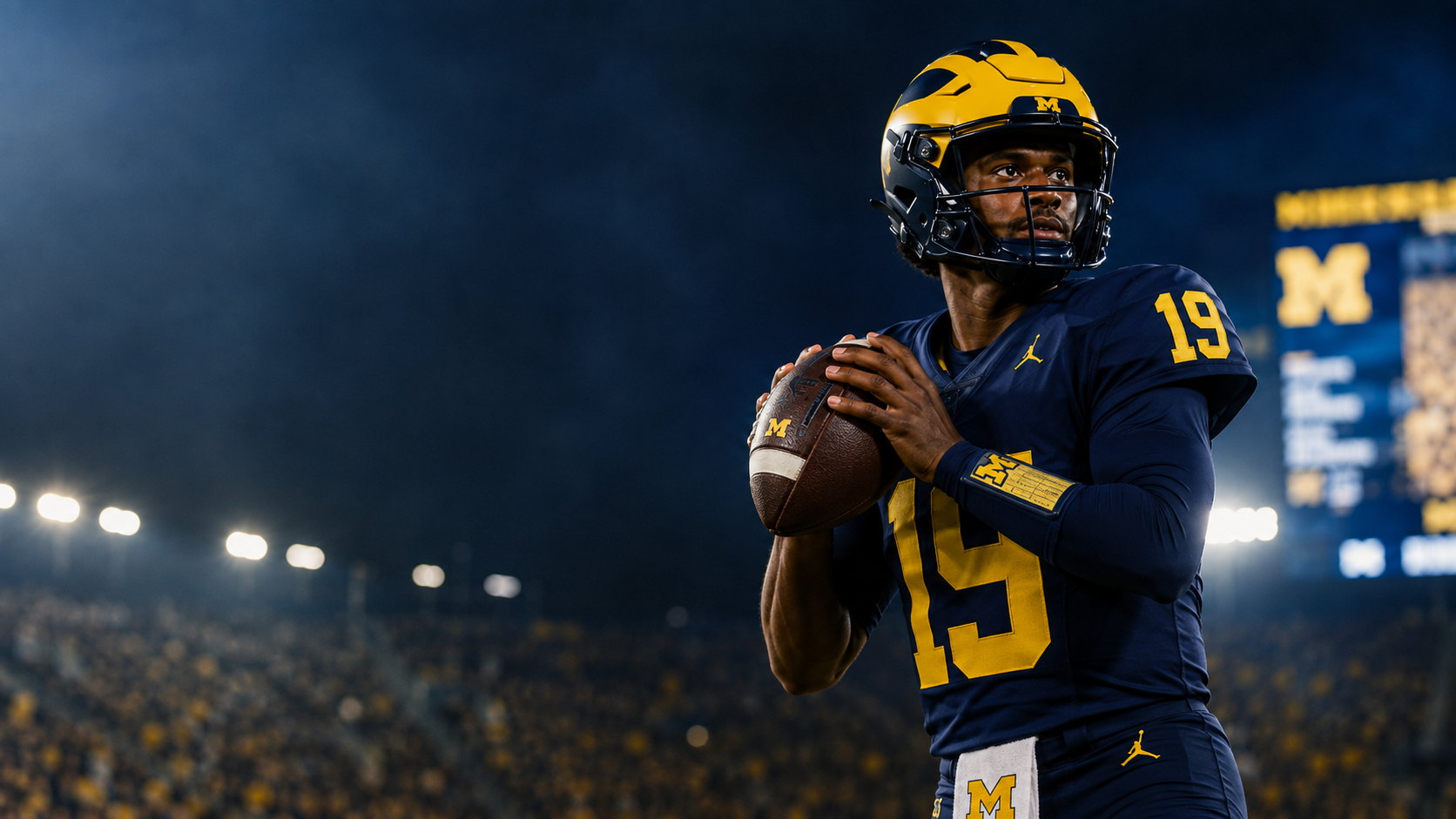
Michigan spent 2025 winning games while the program unraveled off the field. The Wolverines went 9–4, which sounds fine until you fill in the rest: a November loss to No. 1 Ohio State — 27–9, snapping four straight wins in The Game and Michigan’s first defeat in the rivalry since 2019 — a 41–27 Citrus Bowl loss after Texas pulled away in the fourth quarter, and, in the middle of it all, a head coach fired for cause in December. Nine wins wasn’t a football crisis; what happened around the program plainly demanded a reset.
So 2026 is a reset. Utah legend Kyle Whittingham takes over with a nearly all-new staff, and the one constant is the most important one: Bryce Underwood, the most hyped recruit in the country a year ago, is back for his sophomore season as the unquestioned starter. The question is whether a new regime plus a second-year franchise quarterback adds up to a climb back toward the top — or a transition year in disguise.
What BBMI’s model says
This is where we come in. BBMI’s preseason model has Michigan 17th nationally and 6th of 18 in the Big Ten — genuinely good, a top-tier roster, and a notch more measured than the human polls, which slotted the Wolverines around 16th. The model sees a balanced, talented team; it just also sees the schedule.
And the schedule is the story. Unlike a lot of the Big Ten’s middle class, Michigan doesn’t get to dodge the heavyweights: the slate includes a home date with Oklahoma in Week 2, Iowa and Penn State at home, plus road trips to the two teams the model likes best in the country — at Oregon and at Ohio State — and a tricky home game with playoff-caliber Indiana. There’s a soft underbelly (Western Michigan, UTEP, Rutgers, Michigan State, UCLA) that keeps the floor high, but the ceiling runs straight through three teams BBMI expects Michigan to lose to.
The schedule, by win probability
BBMI preseason modelMichigan doesn’t get to dodge anyone — Oklahoma, Penn State, Indiana, at Oregon, at Ohio State are all on here.
Pick the favorites
Pick the favorites straight up and it’s a tidy 9–3 — but that flatters the schedule. The model’s expected-win math is closer to 7.3, because the middle of this slate (Oklahoma, Penn State, Iowa) is a stack of narrow win-leans, not comfortable ones. Worth separating the two quantities, since they aren’t the same thing: model mean, 7.3 wins; most likely neighborhood, 7–5 to 8–4; BBMI’s single-record call, 8–4 — and three games (Indiana, Oregon, Ohio State) the model simply expects Michigan to lose. For a program that measures itself in playoff appearances, that’s the gap between the hype and the math.
Three ways to read the same schedule
Editorial pick vs. model meanThe offseason that changed almost everything
Start with the thing that reshaped the program. The head-coaching job came open in the ugliest way possible: Sherrone Moore, 9–3 at the time, was fired for cause in December over off-field misconduct involving a staff member — an episode that also drew criminal charges, to which Moore pleaded no contest in March on two misdemeanors under a deal dismissing the earlier felony count, drawing 18 months’ probation in April. An independent review commissioned by the university and conducted by Jenner & Block examined the athletic department’s culture and handling of the matter. Athletic director Warde Manuel, who made the call, has since announced he’ll step down at the end of 2026. It was a lot, and it happened fast.
Into that mess Michigan hired Kyle Whittingham — the 21-year Utah institution, 177 career wins — on a five-year, $41 million deal, and he brought his program with him. Out went coordinators Chip Lindsey and Wink Martindale; in came OC Jason Beck (from Utah) and DC Jay Hill (from BYU, whose defense is billed as one of the most complex in the country). The roster followed the same Utah/BYU pipeline through the portal. This is a major staff overhaul wrapped around a roster that was already talented — the kind of reset that can go either direction in year one.
The staff overhaul
MOSTLY NEWTransfer portal: the churn
UTAH/BYU-FLAVORED CLASSThe portal churn was enormous, but the incoming class is unmistakably Whittingham’s — Utah and BYU pieces built to fit the new schemes.
Kyle Whittingham, year one
Here’s the case for calm: Whittingham is one of the best program-builders of his era, a coach who turned Utah into a Pac-12 and then Big 12 power on the strength of defense, toughness, and player development — exactly the identity Michigan wants to reclaim. He inherits an offensive line and a defense that grade among the Big Ten’s better units, a returning franchise quarterback, and a fan base desperate to get back to beating Ohio State. On paper it’s one of the softer landings a first-year coach could ask for.
Here’s the case for patience: it’s still year one. Two brand-new coordinators are installing new systems on both sides of the ball, a chunk of the roster turned over in the portal, and the schedule offers no easing-in period. First-year regimes — even great ones — usually pay a small tax while everyone learns the language. The model’s 8–4 is, in a sense, that tax priced in: a good team, a hard schedule, and a transition all landing in the same fall.
The quarterback question
This is the position that makes Michigan interesting, and his name is Bryce Underwood. A year ago he was the consensus No. 1 overall recruit — a Belleville, Michigan kid who famously flipped from LSU to stay home — and he started from Week 1 as a true freshman, the first Wolverine to do that since Tate Forcier in 2009. The freshman tape was exactly what you’d expect: flashes of stardom, freshman mistakes. He threw for 2,428 yards and 11 touchdowns, ran for another 392 and six scores, and posted seven 200-yard passing games (a Michigan freshman record) — but he also threw nine interceptions, including three in the Ohio State loss, and the turnovers were the season-long knock.
Now he’s a sophomore in an offense being custom-built for him by Jason Beck, whose Utah quarterbacks thrived on movement and play-action. If the year-two leap is real — cleaner decisions, fewer giveaways, the same running threat — Michigan has a genuine star and a much higher ceiling than 8–4. Veteran transfer Brayden Fowler-Nicolosi (Colorado State) adds experience to the room, though true freshman Tommy Carr has emerged as the leading challenger for QB2 entering fall camp. But make no mistake: this season rises or falls on Underwood’s development.
The run game: reloaded, not depleted
Michigan’s backfield lost a starter and barely blinked. Justice Haynes, who ran for 857 yards and 10 touchdowns in seven games before a foot injury ended his 2025, transferred to Georgia Tech — but Jordan Marshall is back after a breakout redshirt-sophomore year (932 yards, 10 touchdowns, 6.2 a carry) and steps in as the clear lead back. Behind him is five-star freshman Savion Hiter, the No. 1 running back in the 2026 class, though depth thins out past the top two after Micah Ka’apana’s injury. Behind a typically strong Michigan offensive line, this is one of the more intriguing one-two combinations in the league — and exactly the kind of downhill run game that takes pressure off a young quarterback.
The running back room
A ONE-TWO PUNCHThe defense: rebuild the rush, trust the scheme
Michigan’s defense was a strength in 2025 under Wink Martindale, particularly against the run, even if it wasn’t elite across the board — the Wolverines allowed 20.4 points a game, 29th nationally. But the NFL took the teeth out of the pass rush. Edge Derrick Moore (a second-round pick by the Lions), linebacker Jaishawn Barham, and defensive lineman TJ Guy are all gone, a trio that combined for the bulk of the team’s sacks. Rebuilding that front is job one for new coordinator Jay Hill.
He’ll do it with a familiar blueprint and familiar names: a heavy infusion of Utah defenders — projected starter John Henry Daley on the edge, tackle Jonah Lea’ea, and All-Big 12 corner Smith Snowden — layered onto returning talent like versatile DB Zeke Berry and corner Jyaire Hill. Oklahoma transfer Taylor Tatum, a running back turned defensive back, is listed at safety on the 2026 roster. Hill’s scheme has a reputation for complexity and disguise, which can travel well when the talent is there. The pieces are, on paper, a top-half Big Ten defense again. The caveat is the same one facing the whole team: a new system, installed fast, tested early.
The in-state angle
Every other team in this series has told some version of a thinning-pipeline story. Michigan’s is the opposite. The Wolverines didn’t just hold serve in-state — they landed the single biggest recruiting prize in the country and kept him home. Bryce Underwood, out of Belleville, was the No. 1 overall player in the 2025 class, and his decision to flip from LSU back to Michigan was the offseason’s defining recruiting moment nationally. When your in-state headliner is the best prospect in America, the pipeline is doing just fine.
There’s more coming, too: 2026 quarterback signee Tommy Carr is a Saline, Michigan product, part of a class that keeps a foot firmly planted in the state even as Whittingham’s staff casts a national net. For a program whose identity has always been tied to Michigan kids, keeping the Underwood-level talent at home is the strongest possible statement.
BBMI is rolling out college football coverage as the season approaches, and Michigan is one of the first teams up. Model ratings are preseason and update as real games are played.
2025 record, Citrus Bowl, and The Game result (Wikipedia, ESPN, mgoblue, Sports-Reference); Sherrone Moore fired for cause and Warde Manuel stepping down (ESPN, Detroit News, NBC News); Kyle Whittingham hire and 5-year/$41M deal, coordinators Jason Beck and Jay Hill (On3, ESPN, MLive, Deseret); Bryce Underwood 2025 stats, true-freshman start, and 2026 return (Wikipedia, ESPN, CBS, Fox); Belleville hometown / LSU flip and Tommy Carr / Saline (Wikipedia); RB room — Jordan Marshall, Justice Haynes to Georgia Tech, Savion Hiter, Taylor Tatum (Detroit News, 247Sports, SI, CBS); defense — 2025 ranking, Derrick Moore/Barham/Guy departures, Utah transfer additions, returners (Maize n Brew, Wikipedia, Yahoo); transfer portal in/out (SI, Maize n Brew); Ohio State rivalry history, four-game streak, 2024 flag-planting fines (CBS, SI, Wikipedia); 2026 schedule and outlook (Wikipedia, SI, College Football News); Moore no-contest plea and probation (ESPN); Jenner & Block independent review and Manuel departure (WDIV); 2026 roster — Underwood No. 19, Taylor Tatum at safety (mgoblue.com); 2025 scoring defense rank (Sports-Reference); QB2 and RB depth reporting (Maize n Brew); Citrus Bowl fourth quarter (mgoblue.com). National and conference rankings, win probabilities, expected wins, and the 8–4 record projection: BBMI preseason model, July 2026. Win probabilities are model outputs.
Disclosure: analytical and educational content about model performance. Rankings, predictions, and probabilities are model outputs — not financial or betting advice, and past performance does not guarantee future results.
Continue the series: 2026 Big Ten Football Previews
Eleven Gone to the NFL, Still No. 1: Ohio State's 2026 Season, by the Numbers
Ohio State sent eleven players to the NFL, four of them in the top eleven picks, and lost eight defensive starters. BBMI still grades the Buckeyes 1st nationally at +37.6 and 1st of 18 in the Big Ten, with the No. 1 defense and No. 2 offense by SP+ input — the exact mirror of Oregon, 1.7 neutral-field points behind. They are favored in all twelve games, and the projection is still 10–2: a slate this hard costs even the No. 1 team a game or two.
#1 nationally · +37.6 · 1st of 18 Big Ten · 10–2 projected · favored in all 12NCAAF · Season PreviewEverything But the Trophy: Oregon's 2026 Season, by the Numbers
Two straight 13-win seasons, two straight Playoff exits, and twice in 2025 the same team standing in the way. BBMI grades Oregon 2nd nationally at +35.9 and 2nd of 18 in the Big Ten, 1.7 neutral-field points behind Ohio State, with the No. 1 offense and No. 2 defense by SP+ input and a quarterback who turned down the NFL. The projection is 10–2, and exactly one rated game on the schedule makes the Ducks an underdog: November 7 in Columbus.
#2 nationally · +35.9 · 2nd of 18 Big Ten · 10–2 projected · 38% at Ohio StateNCAAF · Season PreviewSixteen-and-Oh, Then the NFL Came Calling: Indiana's 2026 Season, by the Numbers
Indiana went 16–0 and won the first national title in the program's 139-year history, then sent a program-record eight players to the NFL — including Heisman winner Fernando Mendoza at No. 1 overall. Curt Cignetti reloaded through the portal again. BBMI grades the Hoosiers 5th nationally, 3rd of 18 in the Big Ten, and a projected 10–2 (~7–2): about 9.7 expected wins, no Oregon on the schedule, and exactly one game the model makes them an underdog — Ohio State, at home, on October 17.
#5 nationally · 3rd of 18 Big Ten · 10–2 base case · Ohio State ~40% Oct 17NCAAF · Season PreviewReload in Lincoln: Nebraska's 2026 Season, by the Numbers
Nebraska is coming off back-to-back bowls for the first time since 2015–16 and a coach locked up through 2032 — then lost quarterback Dylan Raiola to Oregon and All-American back Emmett Johnson to the NFL Draft. BBMI grades the Huskers 37th nationally, 10th of 18 in the Big Ten, and a projected 6–6 (3–6): about 6.2 expected wins, a cupcake non-conference tray, a vicious back half, and a Black Friday trip to Iowa where the model makes them an 8-point underdog.
#37 nationally · 10th of 18 Big Ten · 6–6 base case · Iowa ~34% (8-pt dog)NCAAF · Season PreviewRow the Boat, Again: Minnesota's 2026 Season, by the Numbers
Minnesota is coming off 8–5 and a bowl win with almost everyone back — the coach, the quarterback, the star running back. BBMI grades the Gophers 50th nationally, 12th of 18 in the Big Ten, and a projected 7–5 that sits right on the six-win bowl line: about 6.0 expected wins, four true toss-ups, a defense reloading after losing an All-America safety to Oregon, and a fall of three rivalry trophies capped by an Axe game the model calls the closest on the schedule.
#50 nationally · 12th of 18 Big Ten · 7–5 base case · Axe ~53–47 MNNCAAF · Season PreviewCan the Badgers Climb Off the Floor? Wisconsin's 2026 Season, by the Numbers
Wisconsin is coming off a 4–8 collapse, the Air Raid finally buried, and a coach on the hot seat. BBMI has started modeling college football and the Badgers are one of the first teams up: 67th nationally, 17th of 18 in the Big Ten, and a projected 5–7 (3–6) that's softer than the record looks: about 5.5 expected wins, four true toss-ups short of a bowl, and a season-closing Axe game that grades as the closest call on the schedule.
#67 nationally · 17th of 18 Big Ten · 5–7 base case · Axe ~53–47 MNRelated research
BBMI NCAAF Power Rankings, Week 3: Georgia Takes No. 1, Texas Lands the First Punch, and Oregon Already Has a Problem
The BBMI Top 25 after three weeks, with every move measured against the September 8 board. Georgia is No. 1 at +37.1, Notre Dame is the model's title favorite at 20%, Texas has beaten the team that started September on top, and Oregon has fallen seven spots after Stillwater.
Georgia +37.1 · Notre Dame 20% title · Utah ▲10 · Oregon ▼7NFL · Season PreviewDetroit Is the NFC North Favorite. The First Month Will Test It.
Jared Goff and one of the NFL’s best offenses give Detroit a championship ceiling. A rebuilt offensive line and four games without Brian Branch and Kerby Joseph give it an immediate problem. BBMI rates the Lions fourth of 32 at +4.8, projects 11.5–5.5 with an 86% playoff chance, and makes them 60% to win the division.
#4 of 32 · +4.8 · 11.5–5.5 projected · 86% playoffs · 60% NFC NorthNFL · Season PreviewWhy Plus-22 Is Unlikely to Repeat: Chicago’s 2026 Season, by the Numbers
Chicago won the NFC North at 11–6 behind the best turnover margin in football, and two defenders who accounted for 15 of those 33 takeaways are gone. Pro Football Reference put the Bears at 9.1 expected wins; they won 11. BBMI rates Chicago +1.6, 15th of 32, and projects 9.3–7.7 with a 47% playoff chance — first team out of the projected NFC field.
#15 of 32 · +1.6 · 9.3–7.7 projected · 47% playoffs · 18% NFC NorthSee it live
The live model behind this piece — the same numbers the article is built on.