What losing Aaron Judge actually costs the Yankees
Aaron Judge has not played since May 31. So we ran the rest of the season thousands of times with him in the lineup, and thousands more without him, and measured the gap.
When a star goes down, the takes arrive before the evidence. Judge fractured a rib, and the range of opinion ran from “the season is in trouble” to “they will be fine.” Both are guesses. We would rather measure.
Here is the setup. We simulated the remainder of the Yankees’ season two ways. In the first, Judge is healthy and in the lineup the whole way. In the second, he misses a stretch the length of his actual injury, and the Yankees field the lineup they have actually been running without him. Everything else is held identical: the same opponents, the same schedule, the same random bounces in each simulated game. Because the two seasons share their randomness, the difference between them is the Judge effect and not simulation noise. We ran it nine thousand times.
Two honest notes on the method, because the method is the product here. First, this is a duration-matched estimate. We are measuring what an absence of this length costs, not reconstructing the specific games already lost. Second, the replacement is real. The without-Judge lineup is the actual nine the Yankees have used in his absence, with Ben Rice and Paul Goldschmidt sliding up the order and the real backfill filling in at the bottom. The cost we measure is the cost of the lineup they actually field.
The number
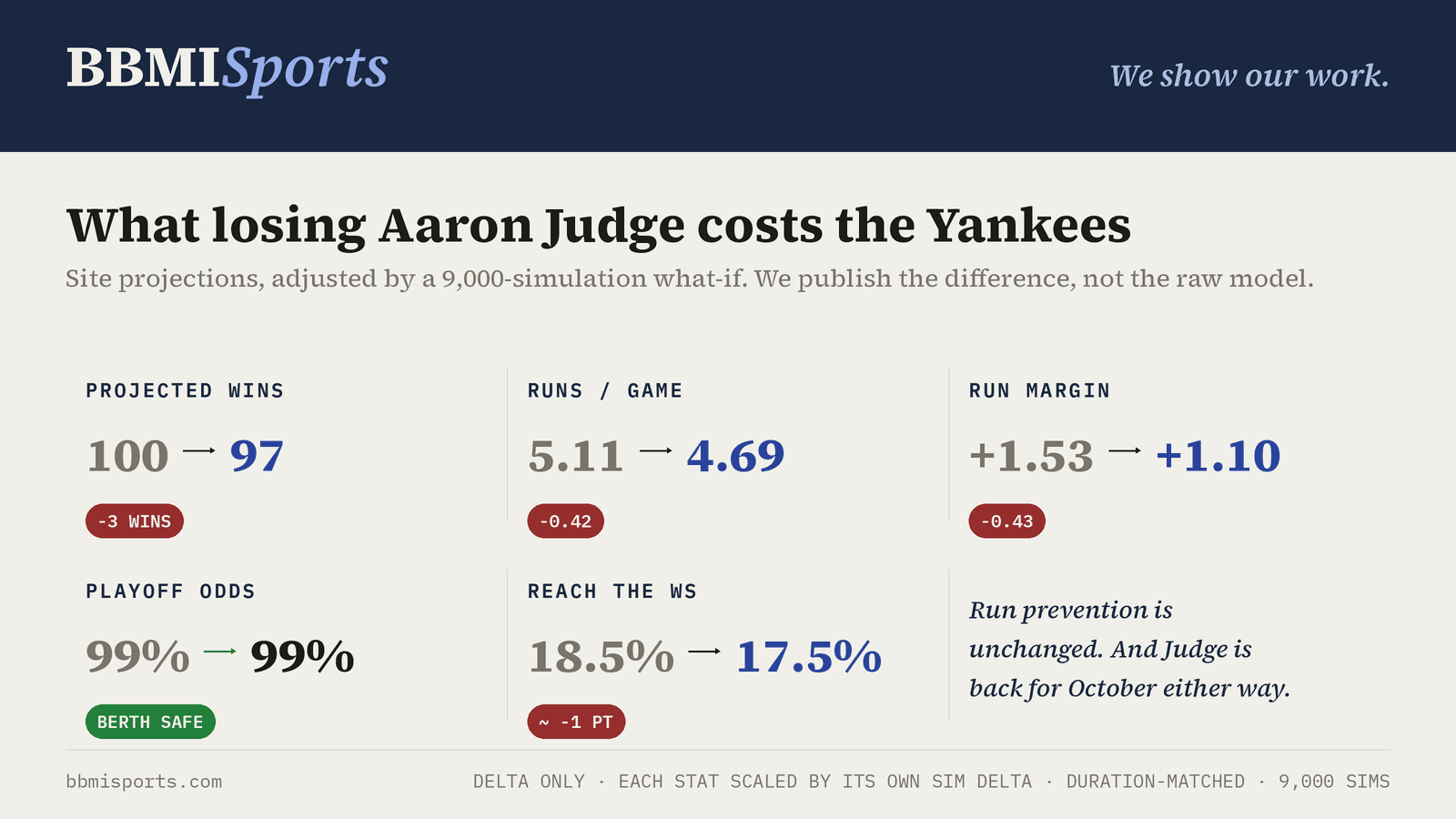
Over the absence, the Yankees lose about three regular-season wins. Run scoring drops roughly eight percent, from a projected 5.11 per game to 4.69. Reaching the World Series becomes about a point less likely. Those figures are real, and they point the same direction across every run. Three wins is not nothing. Losing the best bat on your roster for two months should cost something, and it does. But notice where the cost lands.
The cost is a seeding cost, not a strength cost
Judge is back for October in both seasons. His rib heals on the same timeline whether or not we are simulating it, so by the time the playoffs arrive he is in the lineup in both versions. The postseason rosters are identical, and the entire difference shows up in the regular-season record. Losing Judge does not make the October Yankees weaker. It changes what seed they carry into October.
And that is exactly where it stings, because the AL East is not a coronation. It is a two-team race, and a tight one.
| Team | Record | GB | Proj W | Playoff% | Div% | WS%* |
|---|---|---|---|---|---|---|
| Yankees | 43-27 | - | 100 | 99% | 75% | 18.5% |
| Rays | 41-27 | 1 | 95 | 99% | 25% | 14.2% |
| Blue Jays | 34-38 | 10 | 78 | 23% | 1% | 3.2% |
| Orioles | 34-39 | 10.5 | 74 | 6% | 1% | 1.1% |
| Red Sox | 29-40 | 13.5 | 72 | 2% | 1% | 0.3% |
*Share of simulations reaching the World Series. The Yankees and Rays are separated by a single game, with no third team within ten. So the berth is effectively settled between the two of them, and the live question is who wins the division.
In a race that tight, three wins is not noise. It is plausibly the margin between winning the division and settling for a wild card. The model is telling you the same thing the standings are: this is a fight over seeding, not over whether the Yankees play in October.
Why a Judge-sized hole does not sink them
The lineup has depth, and it has already been tested. Rice has emerged as a genuine middle-of-the-order bat this year, which is why the without-Judge lineup reshuffles rather than collapses. And the Yankees have spent most of the season without Giancarlo Stanton, who has not played since April 24 and just suffered another setback in his recovery. A lineup that has absorbed that and stayed atop its division has shown it can take a hit.
The league cooperates, too. The AL’s best teams sit a clear step below the NL’s top tier this year, where Atlanta, Los Angeles, and Milwaukee are setting the pace across all of baseball. And the part of the team Judge does not touch is the part that holds up: he is a hitter, so the Yankees’ run prevention is identical in both seasons. A team that prevents runs absorbs an offensive dent better than one that has to outslug everyone.
| Projection | With Judge | Without Judge | Change |
|---|---|---|---|
| Projected wins | 100 | 97 | -3 |
| Runs per game | 5.11 | 4.69 | -0.42 |
| Run margin | +1.53 | +1.10 | -0.43 |
| Playoff odds | 99% | 99% | none |
| Reach World Series | 18.5% | ~17.5% | ~ -1 pt |
Method: the site’s published projection scaled by the simulated Judge effect, each stat by its own delta. Run prevention is unchanged (3.59 runs allowed per game in both). Division-title odds, currently 75% in a one-game race, are where the cost concentrates most, and are the next figure we will publish from this run.
The honest summary
An Aaron Judge-length absence costs the Yankees about three wins and a small, real shave off their championship probability. It does not threaten their October berth, because the division has no third challenger and the league has given them room. It does threaten their seed, in a one-game division race where three wins is the whole conversation. The reason a team can lose the best hitter on the planet and keep humming is not that the loss is small. It is that this particular team, with this depth, in this division, is built to convert what would be a season-bending injury for a lesser club into a seeding question.
Method notes. The comparison is a paired simulation, identical in both arms except for Judge’s presence, run nine thousand times, with the absence matched to the real injury’s duration. We publish the difference between the two seasons scaled onto the site’s trusted projections, rather than the raw simulation, because the difference is the part the model measures cleanly. The replacement lineup reflects the Yankees’ actual alignment in Judge’s absence, including genuinely thin rookie samples, which is a real source of uncertainty in the exact magnitude. The reach-the-World-Series figure is the least precise number here and should be read as directional.